TLDR;
- B2B SaaS companies regularly overpay for user acquisition by relying solely on generic "Request a Demo" offers or single-tier targeting.
- By structuring a multi-tier funnel across Meta Ads (TOFU, MOFU, BOFU), we acquired 4,622 software registrations at an average cost of $2.38 each.
- Geographical segmentation is paramount: Worldwide prospecting yielded completions for as low as $0.21–$0.31, while developed markets sat between $1.75 and $3.84.
- Lookalike audiences based on 1% complete registrations and purchasers consistently out-performed broad demographic targeting for niche B2B tools.
- Includes an interactive B2B SaaS Registration & CAC Calculator alongside detailed campaign breakdown metrics below.
Most SaaS founders and B2B marketers have been conditioned to believe that Meta ads simply don't work for software products. The standard narrative claims that unless you are dropping massive budgets on LinkedIn sponsored posts to hunt down executive titles or bidding £25 a click on high-intent Google Search keywords, you won't attract real business users. That line of thinking causes companies to burn enormous amounts of capital on bloated acquisition costs while leaving millions in lifetime value on the table.
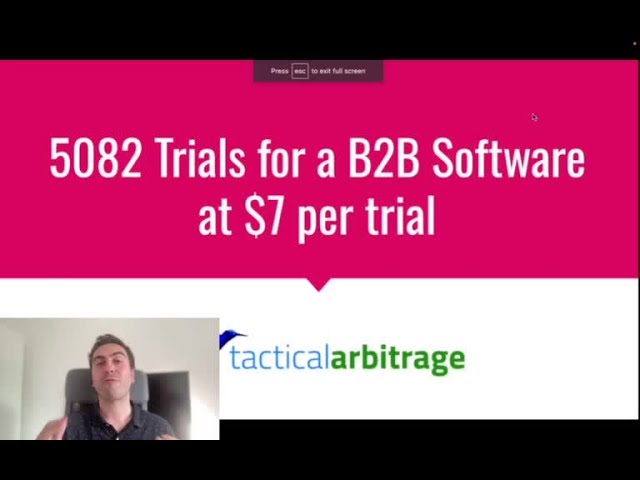
When you take a full-funnel approach built around precise offer friction and structured retargeting, social media channels become an absolute power house for software signups. We recently proved this by taking a B2B Amazon feedback management software—a niche platform built to automate seller review requests and review monitoring—and generating 4,622 user registrations at an average cost of just $2.38 per account sign up. Total spend across the testing period was $11,013.42, yielding a steady stream of prospective trials that converted directly into paid monthly software subscribers.
By clicking play, you consent to load content from YouTube, which will transmit your IP address and may set cookies.
If you've been struggling to scale your own SaaS user base or watching your customer acquisition cost creep into unsustainable territory, this guide breaks down the exact strategy, campaign architecture, creative messaging, and audience targeting frameworks we used to achieve these numbers. You can also explore our detailed breakdown on scaling software registrations with Meta ads for additional contextual strategies.
The Myth of B2B Advertising on Meta
The biggest reason B2B campaigns fail on platforms like Facebook and Instagram isn't the audience—it's the friction of the offer combined with poor campaign architecture. Most B2B advertisers try to force cold traffic directly into a 30-minute sales call or a rigid "Request a Demo" form. They treat Meta like a corporate trade show floor rather than a visual feed where decision makers browse during their downtime.
Business owners, Amazon sellers, and agency executives are human beings who use social media every day. However, when they are scrolling through their feeds, they aren't looking to fill out a 10-field form to talk to a pushy SDR. They want quick solutions to urgent, annoying problems. For an Amazon seller, that nightmare is getting negative feedback that tanks their buy box percentage or wasting dozens of hours manually requesting reviews from buyers.
Instead of pitching a high-friction enterprise contract upfront, our campaign focused on driving immediate free software registrations. We lowered the barrier to entry while using precise ad copy to self-qualify the traffic. People who clicked weren't just curious browsers; they were active sellers looking specifically for Amazon feedback automation.
B2B SaaS Registration & Cost CAC Calculator
Adjust your monthly ad budget, target geographic CPM region, and expected landing page conversion rate to project total registrations and estimated blended CPA.
Architecting the Multi-Stage Funnel (TOFU, MOFU, BOFU)
One of the single biggest mistakes we see in client ad accounts is dumping all budget into a single campaign and hoping Meta's algorithm magically sorts out buyers from browsers. To achieve predictable acquisition costs, you must implement a full-funnel structure. We've detailed this extensively in our guide to the full-funnel paid advertising playbook, but let me show you exactly how it was executed for this B2B software campaign.
We structured the account into three distinct tiers, each with its own budget allocation, optimization objective, and custom messaging:
1. Top of Funnel (TOFU) – Prospecting Cold Traffic
The primary objective here was reaching brand new Amazon sellers and prospective users who had never interacted with the platform. We split-tested geographical regions and audience targeting parameters to find the optimal balance between high registration volume and qualified user quality. TOFU campaigns accounted for the vast majority of overall ad spend.
2. Middle of Funnel (MOFU) – Engagement & Website Retargeting
Cold traffic rarely converts 100% on the first click. Our MOFU campaigns specifically targeted people who had visited the website or engaged with social posts/video ads but hadn't yet completed their software registration. The copy shifted from problem awareness to trust building—highlighting specific product features, automated review request workflows, and ease of setup.
3. Bottom of Funnel (BOFU) – Trial Activation & Paid Conversion
Once a user registered an account, the journey wasn't over. We ran targeted BOFU campaigns retargeting active account registrants to encourage them to stay active during their trial period, connect their Amazon store API, and upgrade to a paid subscription plan. Keeping users engaged during the trial window dramatically increases lifetime value (LTV).
Full-Funnel Campaign & Account Setup Structure
View Text Summary for Accessibility
Full-funnel architecture breakdown: TOFU targets cold audiences via lookalikes and interest groups for initial registrations. MOFU retargets un-registered site visitors to complete account creation. BOFU retargets existing registrants to drive trial usage and paid store connection.
Geographical Targeting: Benchmarking Costs & Quality
One of the most fascinating aspects of this campaign was testing geographical location segmentation. Depending on your software pricing model and target market, where you run your ads drastically impacts your Cost Per Acquisition (CPA).
Many SaaS companies default to running ads exclusively in the United States because it represents their primary revenue market. However, if you are looking to build pixel data quickly or if your software caters to global Amazon sellers (who operate out of Europe, Asia, and Latin America), limiting yourself strictly to the US can be an expensive mistake.
We split-tested three distinct location strategies within our TOFU prospecting campaigns:
- Worldwide Targeting: Generated massive registration volume at extremely low costs, averaging between $0.21 and $0.31 per completed registration.
- Developed Countries Grouping: Targetted tier-1 developed markets (UK, DE, FR, IT, ES, CA, AU). Costs sat comfortably in the $1.75 to $3.84 range per registration.
- US-Only Targeting: The most competitive market, with registration costs ranging from $17.32 to $38.57 per user acquisition depending on ad creative and audience saturation.
By running parallel campaigns, the client was able to maintain high registration volume globally while allocating dedicated budget to high-value US sellers.
Cost Per Registration by Geographic Region
Comparing real CPA data across account campaign tiers
Blended Average CPA
Audience Targeting Breakdown: What Worked & What Failed
When targetting niche B2B personas—like Amazon sellers, Shopify store owners, or digital merchants—standard age/gender demographics won't cut it. You have to leverage specific behavioral indicators and custom audience data points.
Inside the ad manager, we split-tested 9 distinct ad sets across our campaigns to systematically isolate top performers. Here is what the data revealed:
Top Performing Audiences
1. Lookalike Audiences (1% Complete Registrations & Purchasers)
Once our Meta pixel gathered its first few hundred conversions, Lookalike Audiences (LLAs) became our absolute primary growth driver. The 1% Lookalike built off users who had completed account registration yielded 150+ conversions in a single ad set at exceptionally low costs. We also saw strong performance from Lookalikes based on active trials and customer upload lists.
2. Small Business Owners (Behavior)
Meta’s native "Small Business Owners" behavior classification remains one of the best broad B2B targeting filters available on the platform. It consistently pulled in qualified merchants and out-performed standard broad targeting during early account warming stages.
3. Specific E-Commerce & Marketplace Interest Clusters
Instead of stacking random interests together into a chaotic mix, we grouped our interest targeting into clear thematic buckets:
- Marketplace Interests: Amazon Marketplace, Drop shipping, Order fulfillment, Freight transport, Alibaba.com.
- Online Retail Tools: Shopify, WooCommerce, eBay Global, AliExpress, Seller Central integrations.
- E-Commerce Behaviors: Retail page admins, E-commerce Specialists, and business page managers.
Underperforming Audiences We Turned Off
Not every test is an instant winner, and knowing when to cut losses is critical to maintaining a low CPA. During testing, we found that purely Broad Targeting (no interests or lookalikes applied) without sufficient pixel conversion volume resulted in higher costs during early account phases. Furthermore, ultra-broad interests like "Shopping" or "Retail" pulled in far too many B2C consumers rather than actual store operators.
We systematically turned off these underperforming ad sets and re-allocated ad spend directly into the winning 1% Lookalikes and Retail Admin clusters.
Creative Strategy & Copywriting Frameworks That Converted
You can have the best targetting structure in the world, but if your ad creative looks like an uninspired corporate banner, people will scroll right past it. In B2B SaaS advertising, ad creatives must accomplish three specific tasks in under two seconds:
- Stop the scroll by visualising a specific, recognizable pain point or software UI.
- Deliver a direct, value-driven headline that explains the transformation.
- Provide a clear, low-friction Call to Action (CTA) button driving them to register.
For additional copywriting methodologies, you can refer to our guide on the advanced ad creative and copywriting playbook.
Here are the exact copywriting frameworks and ad creative angles that generated over 4,600 registrations in this campaign:
1. The 1-2-3 Formula (Problem - Solution - Action)
This simple layout directly addresses seller frustration before offering the software as the immediate fix.
Example Ad Copy:
"Tired of manually emailing Amazon buyers for reviews? 😤
Automate your entire feedback collection process in under 5 minutes with our automated review tool. Protect your seller rating and boost sales on autopilot.
👉 Click 'Sign Up' to start your free trial today!"
2. Feature-Benefit Angles ("Automate Your Amazon Feedback")
Sellers care deeply about their review ratings because negative feedback directly impacts buy box ownership. We tested specific hook taglines across our ad image variations:
- Headline A: "Automate your Amazon feedback" (Highest Volume Winner – 1,046 Registrations)
- Headline B: "Unlock Amazon success" (Secondary Winner – 633 Registrations)
- Headline C: "Elevate your Amazon brand" (349 Registrations)
- Headline D: "Boost your Amazon sales" (62 Registrations)
Notice how direct functional messaging ("Automate your feedback") dramatically out-performed vague aspirational messaging ("Boost your sales"). Business users respond to practical tools that solve specific operational headaches.
Ad Copy & Headline Performance Comparison
Total completed registrations generated by creative variation
Top 2 Ads Total
Campaign Account Data Breakdown
To give you full transparency into how the account was managed, here is the complete breakdown of metrics across all active campaign tiers during the primary scaling phase:
| Campaign Name | Funnel Stage | Completed Regs | Cost / Reg | Amount Spent |
|---|---|---|---|---|
| LH - MOFU - Complete Registration | MOFU Retargeting | 1,122 | $0.88 | $987.93 |
| LH - TOFU (Worldwide) - Complete Reg | TOFU Prospecting | 1,083 | $0.31 | $336.75 |
| LH - TOFU (Worldwide) - Trials | TOFU Prospecting | 1,013 | $0.21 | $217.57 |
| LH - Promotions (Developed Countries) | MOFU Promo | 419 | $9.29 | $3,890.48 |
| LH - TOFU (Developed Countries) - Reg | TOFU Prospecting | 232 | $5.76 | $1,337.42 |
| LH - TOFU (Developed Countries) - Trials | TOFU Prospecting | 230 | $3.84 | $884.13 |
| LH - BOFU - Trials | BOFU Activation | 156 | $2.02 | $314.68 |
| LH - TOFU (US) - Trials | TOFU Prospecting | 61 | $17.32 | $1,056.65 |
| LH - BOFU - Purchase | BOFU Conversion | 36 | $5.71 | $205.49 |
| LH - TOFU (US) - Complete Reg | TOFU Prospecting | 24 | $38.57 | $925.60 |
| ACCOUNT TOTALS | All Tiers Combined | 4,622 | $2.38 | $11,013.42 |
As you can see from the breakdown above, having a balanced mix of worldwide prospecting alongside dedicated tier-1 retargeting keeps the account's blended acquisition cost extremely low while ensuring high-intent buyers receive necessary touchpoints.
Multi-Channel Expansion: Incorporating Google Ads for B2B
While Meta Ads served as our primary engine for scaling low-cost software registrations, expanding into Google Ads added a crucial layer of high-intent search traffic. On social media, you are interrupting users with a compelling solution; on Google, users are actively searching for a way to solve an urgent problem.
To maximize total acquisition efficiency without cannibalizing budgets, we implemented a dual Google Ads setup:
1. High-Intent Google Search Campaigns
We targetted specific, high-intent keyword clusters related directly to software alternatives and feedback management:
- Competitor Keyword Themes: Bidding on terms like "Helium10 feedback alternative", "Feedback Genius replacement", "Sellerboard review tools". People searching for existing tools are often unhappy with their current pricing or features and are ready to switch immediately.
- Problem-Based Keywords: "How to get reviews on Amazon", "Remove negative Amazon seller feedback", "Automate Amazon feedback requests".
- High-Intent Software Queries: "Best Amazon review software tools", "Amazon seller feedback automation software".
2. Performance Max & Discovery Campaigns
We used Performance Max and Discovery ads across YouTube feed placements, Gmail promotions tabs, and Google Display networks. By inputting custom intent signals—such as people who searched for Amazon seller tools—Google’s machine learning pushed visual software ads to active sellers across the web.
For more details on integrating multi-channel structures, see our comprehensive guide on scaling Meta and Google Ads.
Step-by-Step Optimization Roadmap for B2B Founders
If you want to replicate these results in your own B2B SaaS or service business, follow this structured execution plan:
This is the main advice I have for you:
| Phase | Focus Area | Key Implementation Steps | Success Benchmark |
|---|---|---|---|
| Month 1 | Technical Setup & Retargeting | Install CAPI/Pixel tracking. Launch MOFU retargeting for site visitors. Launch TOFU interest testing (Retail admins, Small business owners). | Establish initial baseline CPA. Accumulate 100+ complete registration events. |
| Month 2 | Lookalike & Creative Scaling | Build 1% LLAs off complete registrations & trials. Split-test copy angles (1-2-3 framework vs feature benefits). Kill underperforming ad sets. | Reduce blended CPA by 30-50%. Identify winning ad headline copy. |
| Month 3 | Geographic & Channel Scaling | Expand top-performing creatives into worldwide vs developed country tiers. Launch Google Search competitor keywords to capture high-intent demand. | Scale account registration volume while holding blended CPA under target threshold. |
Why Working with a Growth Partner Changes Everything
Scaling a B2B software platform isn't just about turning on a Facebook ad and hoping for the best. It requires a deep understanding of unit economics, full-funnel tracking, creative split-testing, and user onboarding friction. As we've shown in our guide on fixing failing Facebook ads and unlocking real profit, small tweaks to offer positioning or targeting can make a tenfold difference in acquisition efficiency.
Most internal marketing teams or generalist agencies focus purely on vanity metrics like link clicks or impressions. They don't take ownership of destination landing page conversion rates, registration friction, or trial activation. We operate differently as growth partners—taking full ownership from the initial click down to landing page copy, multivariate split-testing, and automated chat onboarding.
If you are looking to scale your software product, reduce your customer acquisition costs, or build a predictable acquisition funnel that drives paid users, we can help you structure the right strategy. We offer a free initial strategy consultation where we review your ad account, analyze your current landing page funnel, and map out a tailored execution plan specifically for your business.
Hope this helps!

Lukas Holschuh
Founder, Growth & Advertising Consultant
Great campaigns fail without expertise. Lukas and his team provide the missing strategy, optimizing your entire advertising funnel—from ad creatives and copy to landing page design.
Backed by a proven track record across SaaS, eLearning, and eCommerce, they don't just run ads; they engineer systems that convert. A data-driven partnership focused on tangible revenue growth.